


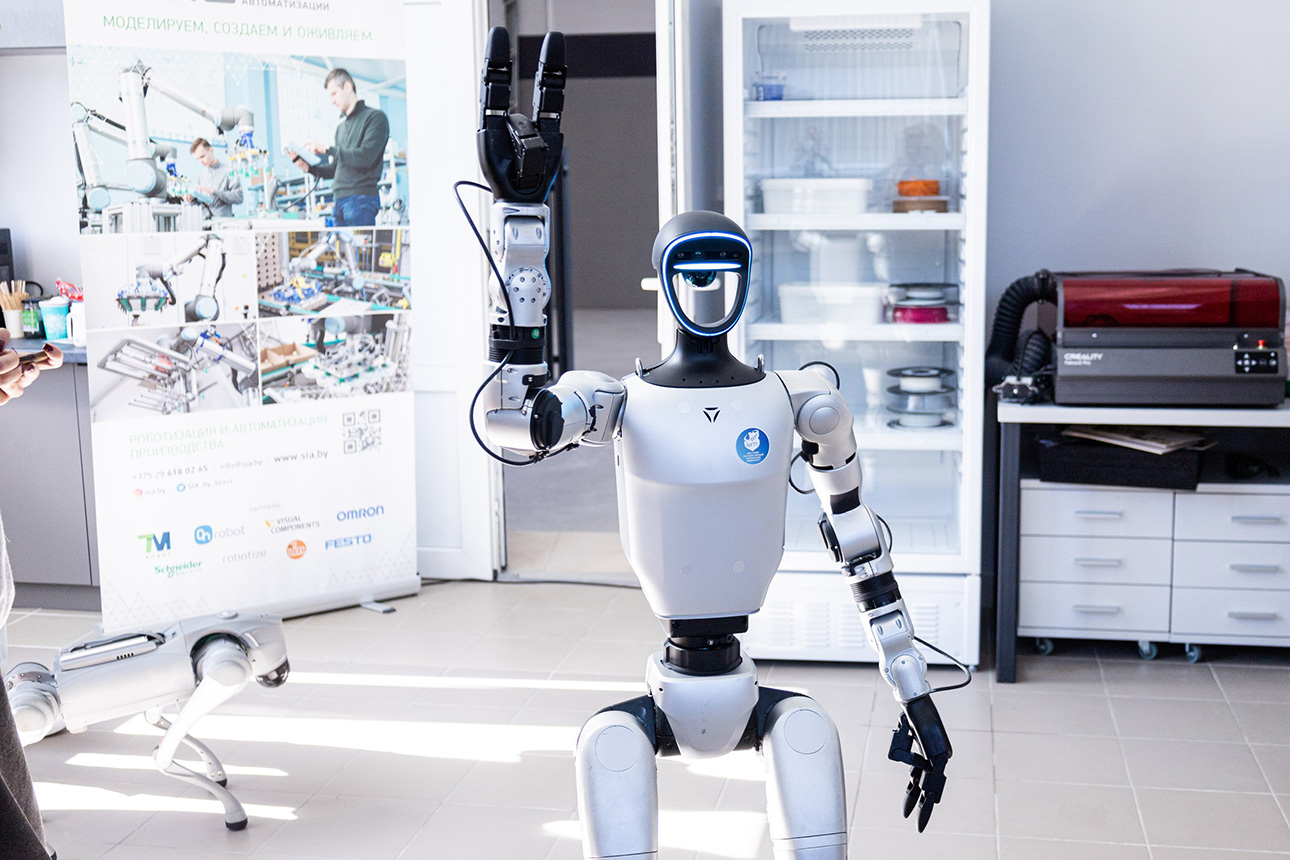
In September, the National Children's Technopark opened its doors for another specialized program session, bringing together 150 of the most motivated and talented schoolchildren from across Belarus. This month, a delegation from Brest State Technical University (BrSTU) had the honor of representing the region's higher technical education sector.
Our instructors did not merely visit the technopark as experts; they took charge of an entire program track, immersing the students in one of the most cutting-edge fields of modern engineering.
Digital Twin and Real-World Humanoid: An Immersion in Anthropomorphic Robotics
Under the guidance of BrSTU specialists, a group of ten students spent three weeks studying anthropomorphic robotics. The training bridged the gap between virtual and physical reality: the students worked with professional simulators before transferring their algorithms to a real Unitree G1 EDU humanoid robot (the educational version) provided by the university.
The students followed a unique program titled "Intelligent Humanoid Robots," developed by the BrSTU Industrial Robotics Laboratory in collaboration with "Industrial Automation Systems," a leading Belarusian developer of robotic complexes.
The program is unique in its combination of two cutting-edge technologies: humanoid robotics and embodied artificial intelligence. Another key feature is the adaptation of complex educational material for school-age students; all topics are presented in a clear, visual, and practice-oriented manner. Over three weeks of intensive work, the young engineers developed and successfully presented a series of impressive projects:
Emergency bracing system: an algorithm enabling the robot to instantly assume a safe posture upon losing balance or sustaining an external impact.
Combat stance and locomotion: training both the digital twin and the physical robot in complex movement patterns that require precise center-of-gravity calculations.
"Cleaning Robot" scenario: a practical task involving programming a humanoid to perform routine household chores.
From learning to real-world production
A true testament to the students' high level of proficiency was that many did not limit themselves to the standard anthropomorphic robotics curriculum. Alongside the main program, the students worked on projects with direct industrial applications, including:
- A part-milling system based on an industrial robotic arm.
- An intelligent warehouse automation system.
- Development of a software platform for the comprehensive modeling of robotic systems.
Investing in talent
BrGTU’s collaboration with these gifted students did not end with the conclusion of the September session. Following the project presentations, university leadership decided to enroll one of the most promising students, Anton Pavlovsky, in a remote learning program specializing in anthropomorphic robotics. This will allow him to continue working on complex engineering challenges under the guidance of university mentors.
The BrSTU Team at the Program Session
The success of this track would not have been possible without the coordinated efforts of our delegation, which included:
- Valery Viktorovich Kasyanik - Senior Lecturer at the Department of Intelligent Information Technologies and Head of the Industrial Robotics and Digital Engineering Laboratory at BrSTU.
- Alla Evgenyevna Osipova
- Ekaterina Sergeyevna Makarevich
- Ivan Gennadyevich Liskovich (student, group AS-67) - provided technical support during the session, helping schoolchildren set up equipment and debug code.
The September session at the National Children's Technopark served as an excellent platform for career guidance and talent scouting. BrSTU reaffirmed its status as a technology leader that not only trains in-demand specialists but also fosters an engineering culture among the country's youngest citizens.
